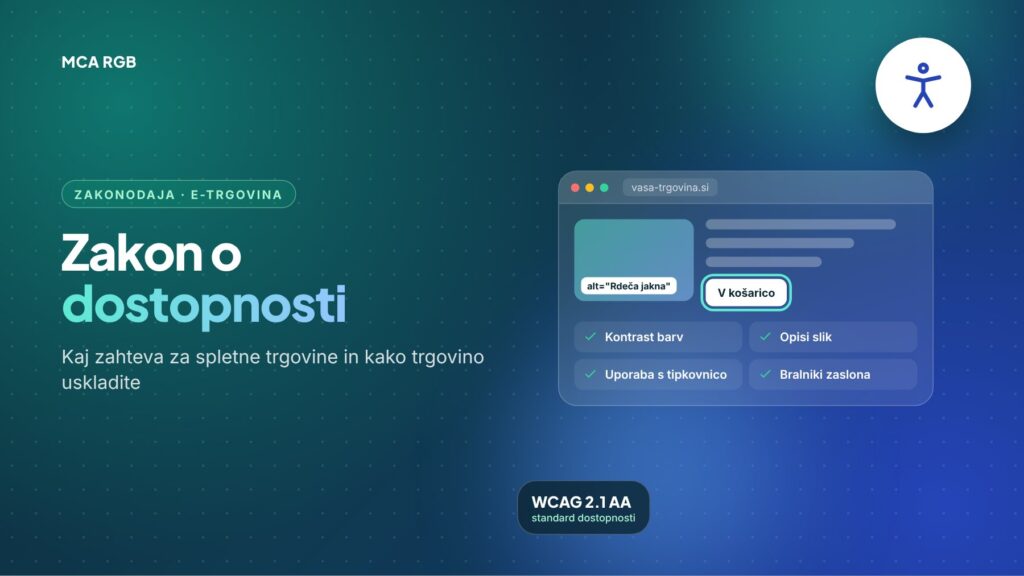
Since 28 June 2025 the Act on Accessibility of Products and Services for Persons with Disabilities (ZDPSI) has applied in Slovenia. It transposes the European Accessibility Act into Slovenian law, and e-commerce is among the services it covers.
An accessible store is not useful only for people with disabilities. It is also clearer and easier to use for older shoppers, for purchases on a mobile phone and for everyone in a hurry.
Who the act applies to
- E-commerce services: websites and apps on which a consumer selects, orders and pays for a product or service.
- The exception for microenterprises: companies that provide services and have fewer than 10 employees and an annual turnover of up to 2 million euros.
- Supervision: for e-commerce the competent body is the Market Inspectorate of the Republic of Slovenia (TIRS). The act provides for fines for providers who do not bring their service into compliance.
- Disproportionate burden: a company can rely on it only if it justifies and documents it. It is not an automatic exception.
This is not legal advice. If you are not sure whether the act applies to you, consult a lawyer.
What an “accessible” online store means
In practice the benchmark is the European standard EN 301 549, which refers to the WCAG 2.1 guidelines at level AA. In short: the store must be perceivable, operable, understandable and technically robust, also for a shopper who uses a screen reader or only a keyboard.
Checklist: 15 points for your online store
Images and content
- All product images have descriptive ALT text.
- The contrast between text and background is at least 4.5:1.
- The page works at 200% zoom without loss of content.
- Videos have subtitles.
Navigation
- The whole purchase can be completed with the keyboard alone.
- Focus is visible, so the shopper always knows where on the page they are.
- Headings (H1, H2, H3) follow each other in a logical order.
- Links and buttons have understandable names, not “Click here”.
Forms and checkout
- Every field has a label, not just a hint inside the field.
- Errors are described in text, not only colored red.
- CAPTCHA has an accessible alternative.
- The cookie banner can be reached with the keyboard and a screen reader.
Information
- The page language is set correctly (for a Slovenian store, to Slovenian).
- Information on the accessibility of the service is published (an accessibility statement).
- Contacts for help are listed, for example e-mail and phone.
How to start in four steps
- An automated check with free tools such as WAVE and Google Lighthouse. They find only part of the problems, so they are just a start.
- A manual keyboard test along the whole purchase path: home page, category, product, cart and checkout.
- Fixes in the theme and plugins. Themes and page builders are often the biggest source of errors.
- An accessibility statement and regular checks with every new feature or redesign.
Plugins that promise accessibility “in one click” do not replace fixes in code and content.
Accessibility also helps sales and visibility in Google
ALT descriptions, a correct heading structure and understandable forms help Google understand the store better. The same goes for AI agents, which more and more often read websites instead of users, as we describe in the article on Google AI Overviews. An easier purchase also means fewer abandoned carts.
Frequently asked questions
Does the act apply to my small store too?
If you have fewer than 10 employees and up to 2 million euros in annual turnover, you are exempt as a service provider. Accessibility still pays off because of your shoppers and Google.
My store was set up before June 2025. Do I have to change anything?
The act applies to services you provide after 28 June 2025, regardless of when the store was set up. Exceptions apply to some older content, for example archived content.
Who checks compliance?
For e-commerce services, the Market Inspectorate of the Republic of Slovenia.
Is an accessibility plugin enough?
No. A plugin can help with individual settings, but it does not fix errors in the theme, forms and checkout.
Planning a new or redesigned online store?
At MCA RGB we build online stores and optimize them for search engines. For a new store or a redesign we take the checklist above into account from the start.
Contact us and let us talk about your store.