Customers expect an answer right away, even at ten in the evening or on a Sunday. An AI assistant on your website answers 24 hours a day, and your team gets time for more demanding work. According to Eurostat, in 2025 roughly one in five EU companies with at least 10 employees used artificial intelligence; in Slovenia the share was around 22%.
Since 2 August 2026 a new obligation also applies in the EU: a visitor must know that they are talking to artificial intelligence. In this article we explain what an assistant can do, where it pays off most, how to introduce it and what the new rules require.
What an AI assistant does for a business in practice
A modern AI assistant is no longer about clicking through predefined menus. It understands a question in natural language and answers on the basis of your content: price lists, terms of business, frequently asked questions and service descriptions.
- Answers frequent questions about delivery, prices, opening hours and returns.
- Helps find the right product or service and takes the visitor to the right page.
- Collects inquiries and contacts and enters them into the CRM.
- Books appointments and sends a confirmation.
- Hands the conversation over to a colleague when the question is demanding or the customer asks for it.
Where an AI assistant pays off most
| Type of business | Most frequent questions | What the assistant takes over |
|---|---|---|
| Online store | Delivery, stock, returns | Answers and product recommendations |
| Service company | Price, appointment, procedure | Collecting inquiries and bookings |
| B2B and manufacturing | Specifications, delivery times | Technical answers from documentation, contact into the CRM |
| Tourism and hospitality | Availability, price list | Answers in several languages |
A simple rule: if your team answers the same questions every day, an assistant pays off.
What the EU AI Act requires from 2 August 2026
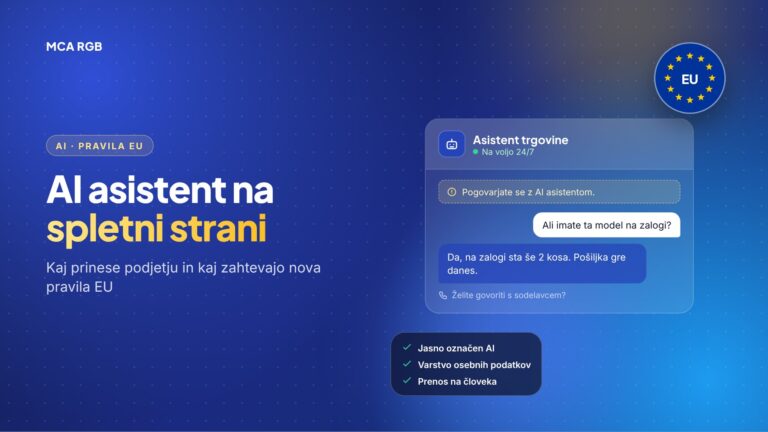
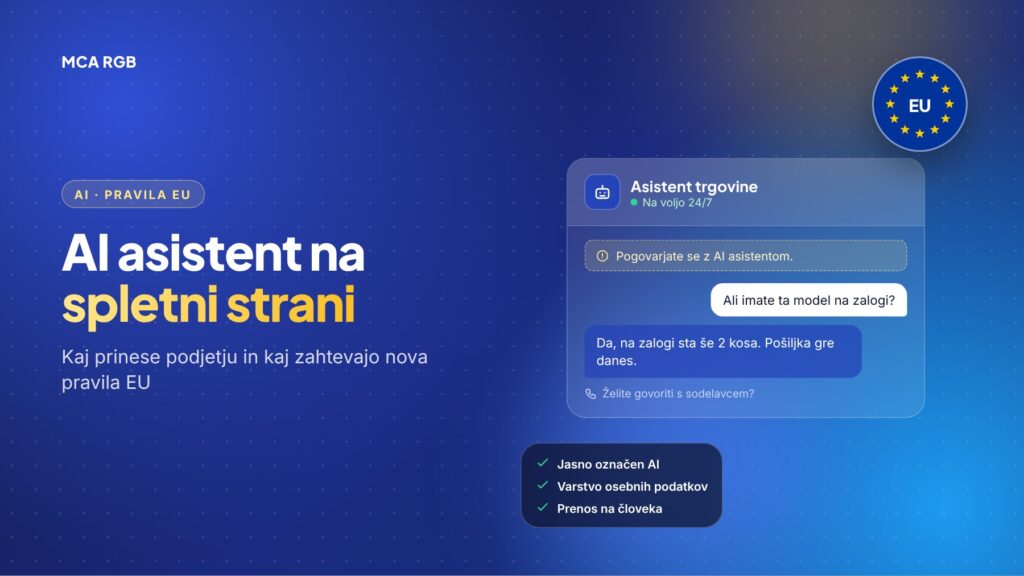
From 2 August 2026, Article 50 of the AI Act on transparency applies. Systems that interact directly with people must be designed so that people are informed that they are interacting with artificial intelligence. The only exception is when this is obvious.
- Who is responsible: formally the obligation lies with the provider of the system. Because the assistant on your site works under your name, the safest approach is to always show the notice clearly.
- Example of a notice: “I am the AI assistant of company X. Answers may be incomplete; for an exact quote I will connect you with a colleague.”
- AI-generated content: if you use AI to create realistic images or videos (deepfakes) or texts on matters of public interest, additional labeling obligations apply.
- Personal data: the assistant processes visitor data, so it must be mentioned in your privacy policy, in line with GDPR.
This is not legal advice. For specific cases, consult a lawyer.
How to introduce an AI assistant in five steps
- Collect the 20–30 most frequent questions from e-mail, phone calls and messages.
- Prepare the knowledge sources: price list, terms, frequently asked questions and service descriptions. An assistant is only as good as your content.
- Set the limits: what the assistant does not answer, for example custom pricing, and when it hands the conversation over to a person.
- Connect it with your systems: CRM, e-mail, calendar and product catalog.
- Test and monitor: read the first conversations, fill in the missing answers and measure the number of inquiries.
The most common mistakes
- The assistant makes up answers because it is not limited to your sources.
- There is no handover to a person, so a demanding customer leaves.
- It is not clear that it is AI, which since August 2026 is also a breach of the rules.
- Collected contacts stay in the chatbot and never reach the CRM.
- Nobody reads the conversations, although they are the best source of data on what customers ask.
The assistant as a source of content ideas
Conversations with the assistant show what customers actually ask. That is an excellent basis for frequently asked questions and new articles. Google also likes to use such content in AI answers, as we explain in the article How to optimize a website for Google AI Overviews.
Frequently asked questions
Does every chatbot have to show that it is AI?
Yes, unless it is obvious. The safest approach is to always show the notice, at the start of the conversation.
Does an AI assistant replace employees?
No. It takes over repetitive questions and hands the more demanding ones to a colleague, together with the full context of the conversation.
Does the assistant speak Slovenian?
Yes. Modern language models answer well in Slovenian and in other languages, which is useful for foreign visitors.
What do I need to get started?
A list of frequent questions and the existing content on your website. How long the introduction takes depends mainly on how many systems (CRM, calendar, catalog) we connect it with.
Need an AI assistant for your website?
At MCA RGB we set up an AI chatbot that answers on the basis of your content, has a clear AI notice, hands the conversation over to a colleague and enters inquiries into your CRM. Read more about what we can automate on the AI automation for business page.
Contact us and we will prepare a proposal for your website.